At a glance
- Common format
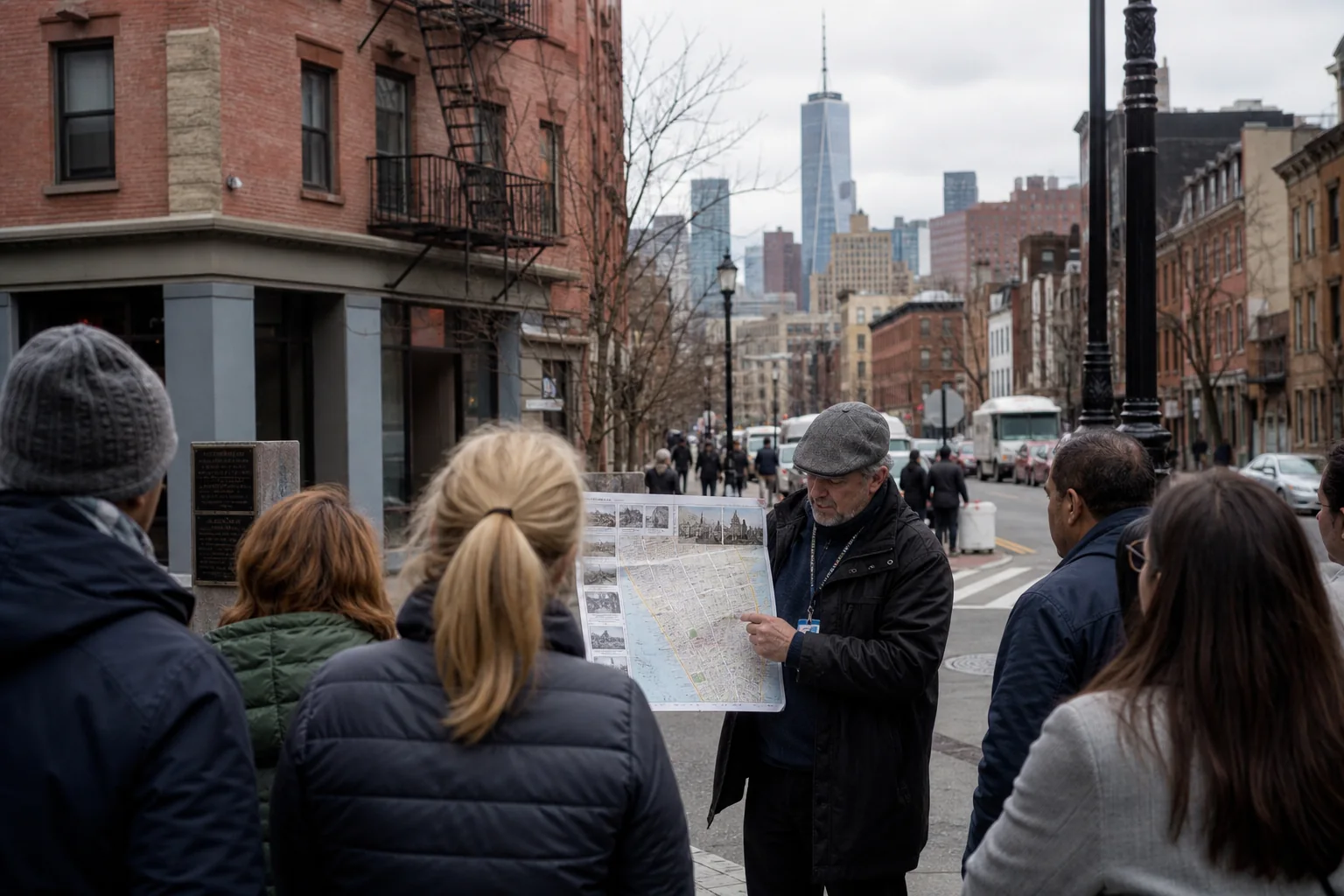
- Neighborhood walking tour
- Planning
- Check distance, stairs, and weather
- History rule
- A location does not prove a story
- Affiliate status
- No tour commissions
What to compare before booking an NYC mob tour
New York tours differ in geography and format. Some stay in Little Italy and the Lower East Side. Others use a bus to reach scattered sites in Brooklyn, Queens, or Midtown. A longer list of famous names does not guarantee a more useful route.
Ask for the starting and ending points, distance, pace, stairs, restroom plan, weather policy, and maximum group size. Then ask the historical question: what source types does the guide use? A tour that can identify a dated court record, archive, or contemporary report gives a visitor something to pursue afterward.
| Format | Strength | Tradeoff |
|---|---|---|
| Lower Manhattan walk | Street and neighborhood detail | Limited geographic range |
| Vehicle tour | Reaches dispersed locations | Traffic and brief views |
| Food-and-history walk | Links commerce and migration | Crime history may be secondary |
| Private custom route | Can follow a research question | Higher price and variable guide quality |
Little Italy and the Lower East Side are living neighborhoods
A responsible route explains migration, tenements, work, faith, food, reform, and changing boundaries. Organized crime is one part of that history. The Tenement Museum offers a different institutional lens on immigrant and migrant life in the Lower East Side; it can help correct a tour that treats the neighborhood only as scenery for famous defendants.
Street names and building uses change. A restaurant may occupy a historic address without having the same owner, interior, or social role. A demolished building can survive as a point on a map but not as an untouched “mob landmark.”
How to check a famous claim
Break the story into parts. Did the person exist? Was the person at this address on the stated date? What event is alleged? Which record connects the three? A photograph may identify the facade but not prove a private meeting. A later memoir may describe the meeting but misremember the room.
Legal wording matters. An arrest, charge, conviction, acquittal, reversal, and cooperation agreement are different events. The Department of Justice’s racketeering manual shows the complexity behind federal organized-crime cases; a walking-tour sentence should not flatten that process.
Residents, workers, and victims are not props
Keep groups clear of doorways, photograph only where permitted, and do not ask a current employee to validate an old rumor. A private residence is not public evidence because a famous person once lived nearby.
Violence should be placed in consequence. Who was injured or killed? What did extortion cost a business or worker? How did corruption affect public services? A tour can be entertaining without asking visitors to admire coercion.
Practical planning
Wear shoes for broken pavement and long standing. Check transit at both ends rather than assuming the walk returns to its start. Summer heat, winter wind, heavy rain, and street festivals can materially change a Lower Manhattan route.
If accessibility information is missing, contact the operator before booking. Ask about curb cuts, subway use, indoor stairs, seating stops, amplification, and service animals. Do not infer accessibility from the word “walking.”
One Wal does not endorse an operator or earn a commission. Provider schedules, guides, and ownership can change faster than a historical framework.
A Little Italy and Five Points walking route
A common mob tour NYC route begins around Little Italy and moves toward the former Five Points area. That short distance crosses several historical layers: nineteenth-century tenements and gangs, later Italian immigration, twentieth-century restaurants and social clubs, courthouse districts, urban renewal, and present-day tourism. A mafia walking tour should tell visitors when the neighborhood boundary changed rather than suggesting that today’s Little Italy matches a map from 1900 or 1930.
Potential stops include Mulberry Street, former social-club addresses, churches, courthouses, and streets associated with widely reported events. The stop itself proves only location. The guide still needs to connect a person and event to the address through a dated record. Five Points stories require an especially clear timeline because nineteenth-century gangs are not the same institution as twentieth-century La Cosa Nostra.
How a New York mob tour should operate
A responsible New York tour begins with the meeting point, expected distance, finish location, and accessibility limits. It tells the group whether food, transit, or interior admission is included. Private tour options should state the minimum charge and what can actually be customized.
Guide qualifications are not limited to degrees. A capable guide may be a researcher, performer, journalist, or licensed sightseeing professional. What matters is whether the mob tour makes its sources visible, corrects errors, and distinguishes a charge from a conviction. Testimonials can describe customer satisfaction; they cannot prove historical accuracy.
Conduct on the route
Stay on public walkways, keep building entrances open, and ask before photographing people. Do not treat a restaurant employee or resident as an exhibit. The best mafia tour places harm, prosecution, and neighborhood life beside the famous names, giving visitors a deeper account than a collection of “secret” mob locations.
Mob tour NYC: a quick comparison
Choose a Lower Manhattan walking tour for street-level context in Little Italy, the Lower East Side, Five Points, and the courthouse district. Choose a vehicle tour if the route genuinely reaches dispersed sites in Brooklyn, Queens, or Midtown. A food-and-history walk may provide richer migration and neighborhood context but spend less time on organized crime. A private mob tour can adapt pace and questions, though price is not evidence of research quality.
Before booking any New York mob tour, verify the exact start and finish, walking distance, stairs, transit use, indoor access, weather policy, and current price. For historical quality, ask whether the guide supplies dates and sources and corrects disputed claims. The best mafia walking tour distinguishes nineteenth-century gangs from twentieth-century La Cosa Nostra and treats present-day residents, workers, and businesses as part of a living city rather than scenery.
NYC mob tour questions
Are NYC mob tours usually walking tours?
Many are, especially in Lower Manhattan. Verify distance, duration, accessibility, and whether transit is involved before booking.
Does a famous address prove an event happened there?
No. The claim should be tied to a dated court, archive, newspaper, or institutional source.
Does One Wal recommend one operator?
No. The page provides a comparison and source-checking framework without a paid or affiliate ranking.